A theater review 「void 03.2025」
Sumi Asaka
I hesitate to begin with something personal, but recently, I lost my father.
I started writing this piece—though I’m not yet sure if it will truly take the form of a “review”—the day before his forty-ninth-day memorial service.
Since my father’s death, I’ve been visiting my family home more often. The reason, of course, is that I worry about my mother, who now lives there alone. Yet every time I look around that house, now emptied of my father’s presence, I can’t help but feel a peculiar emotion—not quite sadness, not quite loneliness, but something different altogether.
I find myself asking:
Was this really ever my home?
Without invoking the Second Law of Thermodynamics, it’s obvious that everything in this world is in a state of irreversible transformation. The person I am today is, however slightly yet certainly, different from the person I was yesterday. Even the self from an hour ago, five minutes ago, thirty seconds ago—before the last blink of my eyes—is no longer me.
It may sound extreme, but perhaps it’s impossible to define the self through the measure of time. The self, after all, is nothing other than an unceasing process of change.
And yet, our consciousness is remarkably dull to such transformation.
The moment we become aware of our own constant flux, our sense of identity begins to crumble.
Now, about the family home.
A family home, at least up to a certain point in life, forms part of who we are.
It may sound dramatic, but one could call it a severed piece of the self.
In that sense, the home is another version of “me.”
Yet, paradoxically, it changes every day—along a trajectory different from my own.
The discomfort that clings to nostalgia.
The intertwining of heimlich (the familiar) and unheimlich (the uncanny).
The family home is our other half, and yet unmistakably, it has slipped out of alignment with us.
We sympathize with the narrator of “void 03.2025” precisely in this sense of uncanniness.
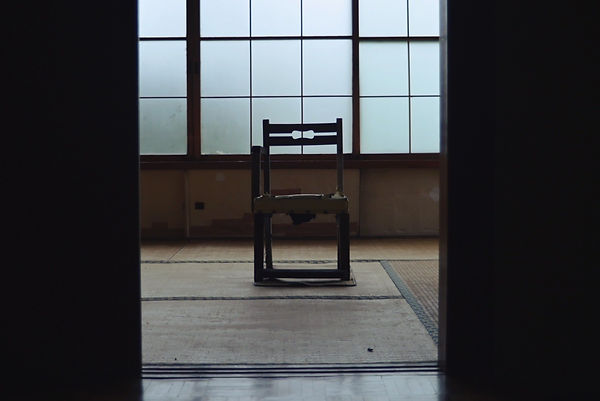
In the living room, emptied of all familiar belongings, there sits only one torn armchair.
And what appears there is nothing less than “my own ghost.”
“When I thought about how no one would know about this house,
and how it might remain even after I disappear—it terrified me.”
Even after I am gone, the house—the family home—will remain.
And it will continue to change, indifferent to my will.
The unease that clings to this image mirrors the feeling we harbor toward ghosts.
In passing from life to death, one’s individuality must undergo some form of transformation.
And even as a ghost, that change would surely go on.
Dragging along traces of who I once was,
it becomes something that is no longer me.
That transformation, above all else, horrifies me.
“void 03.2025”is, in a profound sense, a ghostly work of theater.
Yet the ghost as representation never appears on stage.
What we witness instead is the family home as ghost,
and ourselves—as beings destined to become ghosts in turn.
Or perhaps more accurately: we have always been, and will always be,
in the act of creating our own ghosts.